Showing posts with label film making. Show all posts

Saturday, July 9, 2011


After telling most people that Film Biz Recycling's mission of diverting media production waste from landfills, the most common reply is, "Wow, I never thought about all the stuff left over. " I say, "That's okay, most people that work on a film don't think about it either." But that is changing and we see it everyday.

You are not supposed to be aware of set decoration and design, good art direction is subtle, real and natural. The aesthetic design of the film is imperative to the subconscious belief that the milieu has always existed and this is really happening.

Well, that is accomplished every day, and in it's wake, tons of carpeting, decor, paint, furniture, live plants, plates, wall paper, curtain rods (sigh) the list is endless. Just look around you where ever you are sitting right now. Look at the floor, the walls ceiling, furniture, appliances...if you had to get rid of it in 10 hours and have it spic and span, what would you do? Call a dumpster to haul it away? Well, that has been the answer to many an art department. Some crew don't care, most go home shaking their heads thinking about the shame of it all.


Enter Film Biz Recycling - a not for profit dedicated helping an industry clean its own plate.

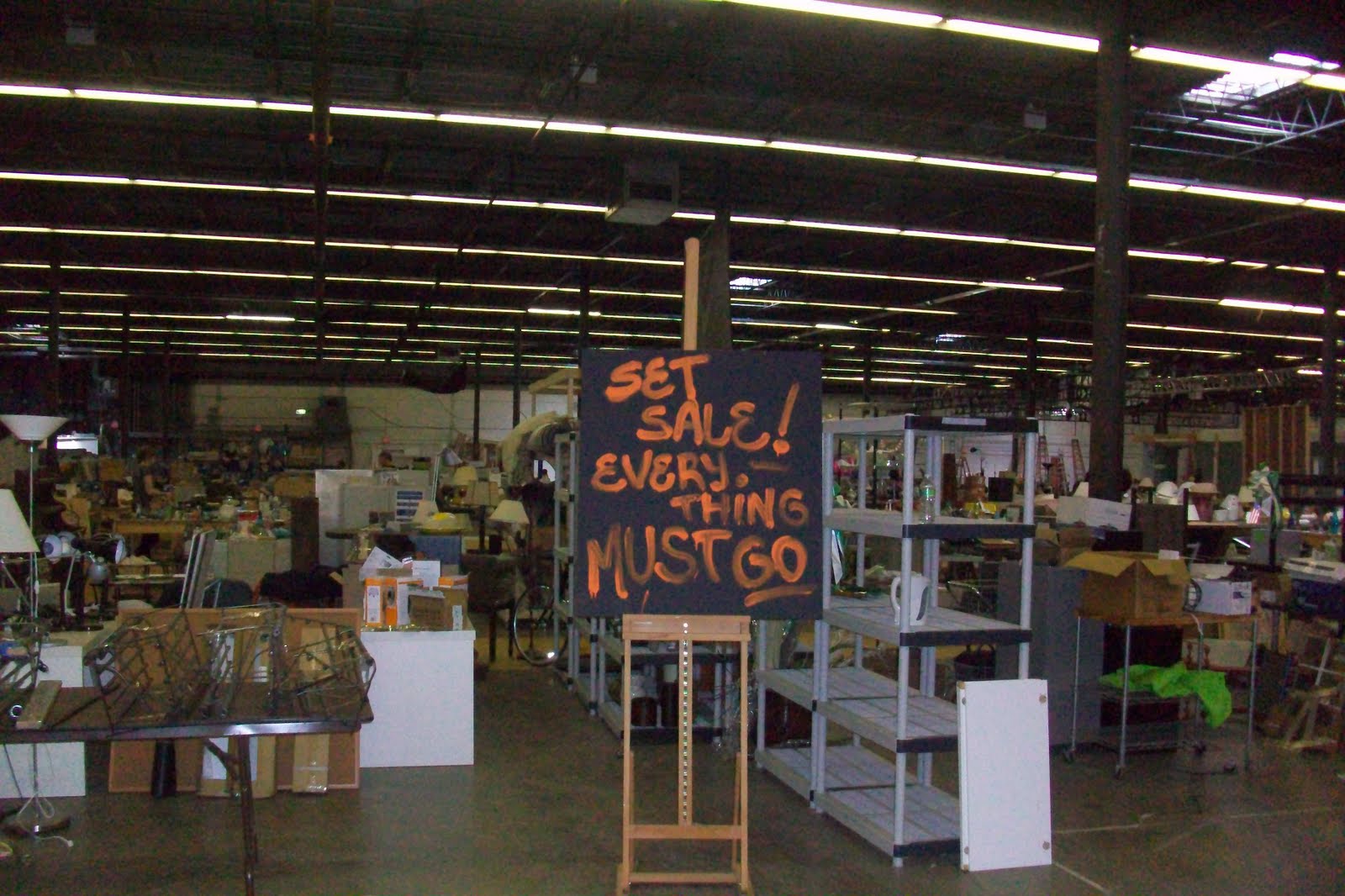
We're film-friendly, teamster savvy, PA-liking, ex-art department crusaders and we want you to drop off all your production's unwanted materials and we'll take of it. 60% goes to charity and the creme de la creme is rented and sold in our Prop Shop to fund the mission. Note that now nine people have jobs and health insurance because of creative reuse and the will of the industry's boots on the ground.


No one really knows how many tons and how much money - that said...

  • a TV show can budget $30,000 an episode x 13 episodes x 4 seasons is $1,560,000 dollars
  • NYC is host to about 15 shows - that's just over $23 million - just in TV show decor
  • NYC usually has about 300 films a year x $60,000 in set decorating budgets= $18 million
  • Approximately 4,000 commercials and videos are shot in NYC have been estimated with an average of $12,000 in set decoration budgets, that's $48 million dollars in purchases.
  • it's not unheard of for a film to spend a million dollars on lumber and trash it all. SALT and Meet Joe Black among them
  • one dumpster holds about 2.25 tons of lumber - a general amount of dumpsters needed after a movie is about 15-35 dumpsters
  • there is no standard for disposing props and set decoration from the top - it's usually decided upon by whatever crew member is in charge.
  • Film Biz Recycling, as a start-up not for profit has diverted 180 tons since 2oo8
  • productions might have had set sales and toss the rest in the "good ol' days".
  • no one is watching

Friday, April 2, 2010

Green Lit at film festivals.....GO!

I saw this film at SXSW - everyone involved in filmmaking needs to see this. Everyone.


-------------------------------------------

In Los Angeles? Then GO!

What: "Greenlit" at the Going Green Film Festival
When: SATURDAY APRIL 3rd
Time: 10:30AM
Location: WGA Theater - 135 South Doheny Drive, Beverly Hills, CA 90211
Run time: 48 minutes.

Parking is available at the WGA garage for $5 or across the street an the open business lot for $3. There's also metered street parking.

You may purchase tickets here- http://goinggreenfilmfest.bside.com/2010/films/greenlit_mirandabailey_goinggreenfilmfest2010

To view the trailer visit: www.greenlit.org


--------------------------------------------
ABOUT THE FILM

Movie people are legendarily liberal and left leaning, particularly when it comes to the environment. Greenlit puts their commitment to the test as filmmaker Miranda Bailey (executive producer of The Squid and the Whale) follows the production of The River Why, starring Zach Gilford (Friday Night Lights) as it attempts to keep an environmentally friendly set thanks to the supervision of a "green" consultant. What starts off with great enthusiasm quickly devolves in this insightful and hilarious film.

OTHER UPCOMING SCREENINGS

April 10th - Ashland Independent Film Festival Ashland, OR http://www.ashlandfilm.org/

April 1-4th - Vail Film Festival, CO http://www.vailfilmfestival.org/

April 8-18th - Dallas International Film Festival, TX http://www.dallasfilm.org/

April 22-26th - Palm Beach International Film Festival, CA http://www.pbifilmfest.org/


FOLLOW "GREENLIT" ON FACEBOOK
Greenlit, THE MOVIE
Reel Green Media
Ambush Entertainment

FOLLOW "GREENLIT" ON TWITTER
Reel Green Media
Ambush Entertainment

Tuesday, June 30, 2009

Death by Chocolate


By Crystal Landes

You’ve been at work for 12 hours now. They’ve just shot that scene, again. You’re tired and you’re hungry. So you head to the craftee table. You see fruits and veggies, but what you really want is something sugary. Chocolate!


Chocolate is an exotic treat, that we, as Westerners have the privilege of indulging in and indulge we do by consuming 3 ½ billion tons every year. That’s a lot of chocolate, which means we have a huge responsibility to use our spending power and change the way the business is run. There are three main issues that come with every Snickers, Twix or bag of M&M’s you eat. First the packaging is not made out of recyclable materials, secondly the cocoa is not fair trade and third it’s not shade grown.


400 million M&M’s are made daily. None of the wrappers for any sweets made by the Mars Inc. company, including M&M’s, Snickers, Mars Bars, Skittles, Milky Way or Twix are made out of recyclable material, except for M&M’s Minis, which come in a little plastic tube. If 400 million M&M’s are made daily then we can assume that roughly the same number is made of the other Mars sweets. That comes to approximately 8 billion non-recyclable wrappers on a daily basis! How many of these sweet confections do you see on your craft services table or in your office snack hub?

By now we’ve all heard the term fair trade and shade grown, but why is it so important? Fair trade ensures that the farmers get just that, a fair market value for their product. For every US dollar spent on chocolate, huge companies who deal in non-fair trade get 70 cents, while the farmer only gets 5cents. Shade grown again means what it sounds like, that the cocoa is grown in the shade. This is important because cocoa is happiest growing in the shade provided by other trees canopy, but more importantly because non-shade grown cocoa is contributing to the massive amounts of deforestation that takes place every day. This was made possible in the 1970’s during the “Green Revolution” when they genetically modified cocoa plants to make them able to grown in full sun.
Now I have to admit here, I feel Mars, Inc. is in a similar position as McDonald’s was when Supersize Me came out. While other peer companies are acting in similar ways these two companies seem to get the brunt of the blame. So let’s get this straight, alongside Mars, Inc., these large companies are not using fair trade cocoa: Hershey, Nestle, Russell Stover or Dove. Hershey’s and M&M’s/Mars control 2/3’s of $13 billion US chocolate market.
Because America is the world’s largest chocolate consumer (in 2002 we spent $13.1 billion on the 3.4 billion pounds we consumed) we are in a position to change the way the chocolate industry is run. How? First of all, every dollar you spend is like a vote. You are CHOOSING to buy a product and thus supporting the company, and their values, that make it. We can choose to buy organic, shade-grown, fair trade chocolate. Some national companies who use fair trade, shade grown, organic cocoa are Dagoba, Endangered Species Organic Chocolate, Green & Black’s and many more. But even better are the local artisan chocolate shops such as Jacques Torres Chocolate located in Brooklyn and Manhattan and Travel Chocolate, which is sold at Grand CafĂ© and Village Farm and Grocery, both located in Manhattan. Secondly, we can look for wrappers that are made from recycled materials. In addition, we can urge the large companies to use recyclable packaging by calling their toll free numbers, some of which are listed below. Over 70% of the worlds chocolate comes from Africa. While that may seem like worlds away, we can start to make a difference here in the US by making changes in our daily spending habits, personally for ourselves and professionally in our offices.

Hershey 800-468-1714
M&M/Mars Inc. 800-627-7852
Nestle 800-851-0512
Russell Stover 800-777-4028
Dove 800-551-0704

Tuesday, April 7, 2009

A 12 ton week!


The week of March 30th 2009 was a big week for Film Biz Recycling, charities and the environment. Instead of filling dumpsters, the New York City film industry is choosing to address environmental and social bottom lines by donating all goods to Film Biz Recycling. We, in turn, donate 90% of the donations to local charities.

The reuse center is coming right along!


Here's how the week went down:

We received donations from:

Life on Mars ( TV show)
Away We Go (feature)
Jack Goes Boating (feature)
The Extra Man (feature)
and 2 commericials

Lots of boxes and sorting and heavy lifting. All in all, last week was an estimated 12 TON week - lots of stuff, but not all of it we keep - not even close.

New York Clothing Bank got all the wardrobe sent directly to their warehouse.

Materials for the Arts is picking up a half a truckload from us next week.

Hour Children is picking 8 boxes of new children's clothes and toys.

Housing Works had an entire truck of beautiful furniture go directly to their warehouse as well a weekly pick up of used bubble wrap and used boxes (they do a lot of shipping)

Build it Green received 12 sinks, plumbing, lighting and some beautiful furniture.

Goodwill received two huge loads of home goods and clothing.

It's really amazing to watch the film industry contribute to all these different organizations. As an industry, I see more and more responsible decisions being made. We all have horror stories about dumpsters and perfectly good things going to waste. Slowly and surely that will be a practice in the past.

We do keep about 10% of the item for our Reuse Center and prop house. It helps us sustain operations and continue to advocate and research sustainable practices related to media production.

If you'd like to donate to Film Biz Recycling click here!

Saturday, March 21, 2009

Coen Brothers Compost and divert 11.1 tons

Guest writer for Film Biz Recycling, Shannon E. Schaefer of
EcoSet Consulting, LLC, writes of her experience. Amazing!

11.1 Tons of Waste, Diverted

Last fall I had the honor to work on the Coen Brother’s latest feature film, “A Serious Man”. Throughout the 44 day shoot, and with the support of FOCUS Features we were able to divert 11.1 tons of set waste. Nearly 80% of the 14 tons of trash produced on set did not end up in the incinerators of Minneapolis, Minnesota. How? It was simple. We composted.

We recycled as well. But in the end, recycling our cardboard, bottles and cans accounted for less than one ton (6%) of our total set waste. This low percentage is in part because we provided reusable bottles and water stations, limiting the amount of plastic on set. Plastic water bottles were not totally banned, but the availability of water stations prevented over 10,000 plastic water bottles from being used. Not bad.

What about other 74% of our trash? We returned 10.3 tons of the set waste to the earth, via the age-old practice of composting.

Composting is fantastic. The sheer amount of set waste it can convert to “black gold” puts our old environmental “recycling is good enough” mantra to shame. We were able to compost virtually ALL of our catering and craft service waste: fruit, veggies, meat, bones, dairy, sugarcane plates and bowls, paper and corn cups, corn utensils, and paper napkins. Basically anything that was once an animal or a plant is now compost.

Our compost site wasn’t just any farmer’s pile. With the help of non-profit Eureka Recycling and local hauler Boone Trucking, we sent all of our plant and animal based waste to a commercial composting site. Commercial sites are different than a traditional backyard compost pile because they are well monitored and reach a much higher temperature, thus allowing us to compost alternative “plastic” products such as corn (PLA) cups and utensils.

Compostable vs. Biodegradable and Landfills

There is a common misconception about compostable and biodegradable products and what actually happens when you throw them away. With the rising popularity of “green” caterers and events using the alternative disposable products (corn/potato-ware, etc) I would like to take a moment explain what this actually means for the environment.

Biodegradable material is capable of being completely broken down into carbon dioxide, water and biomass with the aid of microorganisms. Compostable material biodegrades, but only under specific conditions – for example, the regulated high temperatures of a commercial composting site.

All of the PLA (polylactic acid, usually made from corn) products biodegrade only in high temperature compost conditions. Some potatoware and bagasse plate/bowl products (bagasse is the fibrous material leftover after sugarcane juice is extracted from its stalk) may biodegrade more readily, but do so fastest when in a controlled compost environment.

These organic based disposable products are a good alternative to plastic, which can take hundreds of years to decompose. It is also favorable that often they are produced in a more sustainable fashion than their plastic counterparts. But this is where the green party ends. When you throw your corn fork in the trash it goes to a landfill and as it breaks down it produces the same green house gas, methane, as any other garbage. Not only that but the organic acids produced in the biodegradation process create a toxic heavy metal leachate. Who would have thought corn to be so foul?

When the same PLA fork gets commercially composted, hydrolysis and microbial action breaks it down into carbon dioxide and water. Better? Yes. Perfect? No. There is no “best practice” when it comes to disposable products. There is still much debate about the sustainability of corn products such as PLA as well as other alternative goods. For now, it’s a step away from plastic and in the right direction. If you really want to be sustainable, use reusable flatware. If that is not an option, compost!

Start Composting on Set

Implementing composting takes a little effort, education and planning, and the resources are not everywhere yet. But demand brings supply. Please support your local haulers and commercial compost sites as well as the craft service and caterers who are attempting to “go green.” If the implementation of one new system was able to bring the Coen Brother’s set to 80% waste diversion so easily, I believe one day all film production sets could be at 100% zero waste. That is when filmmaking will start to become truly sustainable.


Shannon E. Schaefer
EcoSet Consulting, LLC
EcoShannon@gmail.com